
 English


| Quantity: | |
|---|---|

The major advantage of employing ethanol as an extraction agent is that it is quite varied in what it can generate, making it very adaptable to the always shifting needs of the market. It excels at extracting a huge variety of desirable hemp and cannabis products. Furthermore, when used properly, it doesn't leave any solvent residue in the finished product, which is why it is frequently referred to as a "clean" solvent.
Due to its capacity to yield a wide range of cannabinoid derivatives, ethanol makes an excellent solvent for both large-scale labs looking to isolate specific cannabinoids like CBD and THC at scale, as well as small-scale cannabis "connoisseur" processors (who may be targeting a wide array of full-spectrum cannabinoids and terpenes).
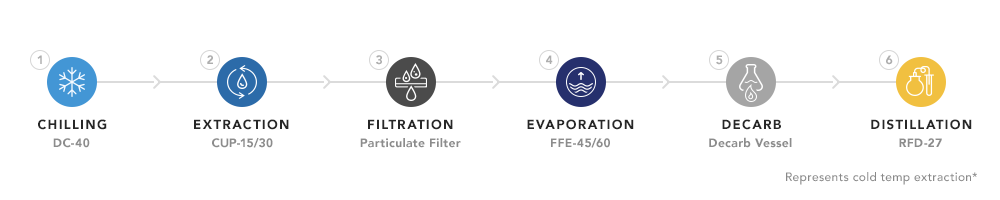
The normal flow of the ethanol extraction process (for our purposes, a Cold Temperature Ethanol Extraction process flow) is as follows:
Chilling: Pre-chill ethanol solvent using the DC-40 Direct Chiller to as low as -40℃ to reduce the need for post-extraction steps.
Extraction: Soak and agitate the biomass in chilled ethanol solvent to extract cannabinoid compounds via CUP Series closed-loop mechanical centrifugation.
Filtration: Remove suspended particulates and adsorbents via Ethanol Extraction Filtration Skid
Evaporation: Remove ethanol from crude oil using the Falling Film Evaporator (FFE).
Decarboxylation: Heating raw ‘acidic’ versions of the cannabinoid molecules (like THCA, CBDA, and CBGA) to release the carboxyl molecule group (AKA “decarbing“) as CO2 and convert them to their more easily consumed versions (like THC, CBD, and CBG).
Distillation: Separating out the purified THC, CBD, CBG, or other desirable molecules from the crude oil utilizing Rolled Film Distillation (RFD).
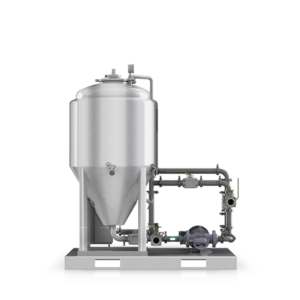
Although ethanol extraction can be performed under room temperature, typically it is performed most efficiently by pre-chilling the alcohol solution to approximately -40°C in an inline chiller such as the DC-40 Direct Inline Chiller.
This first step of the cold ethanol extraction process is performed to increase the efficiency of the solvent’s ability to separate cannabinoids and other desirable compounds from the plant material thereby reducing the number of post-extraction processes. It is for this reason that cold temperature ethanol extraction is more commonly used in large-scale ethanol extraction labs than room temperature extraction.
How does it work?
To reduce the temperature of the ethanol for cold ethanol extraction, an industrial inline chiller (refrigeration system that uses low temperatures to process fluids) rapidly chills the ethanol solution.
When the ethanol solution is cooled down to the desired temperature, it’s then ready for the next stage of the process: to be added into an extraction system such as the CUP Series (Centrifuge Utility Platform) system (see next step) along with high quality cannabis or hemp biomass
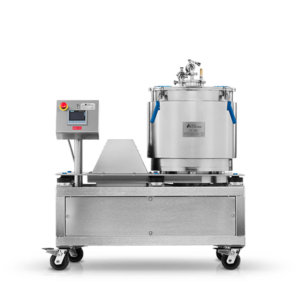
The next step is extraction; where the biomass is soaked and agitated in chilled ethanol solvent to extract cannabinoid compounds within a centrifuge. The CUP Series, otherwise known as the Centrifuge Utility Platform is our state of the art, industry-leading ethanol extraction equipment.
Currently operating in nearly every large-scale cannabis and industrial hemp extraction lab in North America, the recently patented (U.S. Patent #10814338) Centrifuge Utility Platform (CUP-15 and CUP-30 AKA “CUP Series”) works to target and extract compounds from a variety of plant materials including cannabinoid derivatives from hemp and cannabis.
How does it work?
It works similar in action to a top-loading clothes washing machine, the pre-chilled ethanol solution is added to the milled plant biomass to facilitate the initial extraction process. The ethanol soaks the biomass while the CUP agitates to extract cannabinoid compounds via a closed-loop centrifugal force.
Combining a closed-loop, alcohol extraction system with mechanical centrifugation ensuring a high-purity, consistent extraction. Depending on your desired end-product, you can target specific plant compounds through programmable sequences, effectively isolating your desired separation.
The CUP Series boasts 97% alcohol removal from biomass, while also streamlining production times and maximizing extraction yield.
The process is incredibly efficient and fast! The runtime for a CUP-15 extraction system is 15 minutes and for the CUP-30, 20 minutes! This allows operators to process up to 600 pounds of material in a standard eight-hour shift. With the touch of a button, the automated program menu runs the cycle to the user’s specifications.
The resulting output of the CUP extraction machine is a cannabinoid-rich ethanol solution typically known as “tincture” which then needs to be filtered to remove suspended particulates and then evaporated to remove the remaining ethanol.
While you’re using your ethanol solvent to extract precious cannabinoids it pays to optimize each part of the process to maximize efficiencies and increase profitability. The ability to squeeze your margins can make or break your extraction business.
Using a particulate filter will allow for the removal of suspended particulates and adsorbents from your ethanol solution. This means you’ll be able to reuse the same ethanol for multiple extractions. Cannabinoids can be extracted from multiple bags of biomass thereby reducing the cost of production.
How does it work?
To properly and effectively extract cannabinoids, most processors extract with cold ethanol which requires the chilling of large amounts of ethanol quickly to very cold temperatures (see step 1 above of the process using the DC-40 Direct Chiller).
One of the best ways to optimize this part of the extraction process is to saturate your ethanol solvent with as much cannabinoids as it can hold to minimize the amount of ethanol you need to evaporate later on. This saturation is achieved by extracting multiple bags of biomass in the CUP-15/30 with the same volume of ethanol.
This is the point in the process where the lenticular filtration skid comes into play. The skid filters the ethanol between extractions on the CUP-15/30 machine to allow the DC-40 to maintain solvent temperature so that the same solution can be used for up to 3 bags of biomass. The end-result is an ultra-saturated ethanol solution (crude oil) that is ready to go into the evaporator.

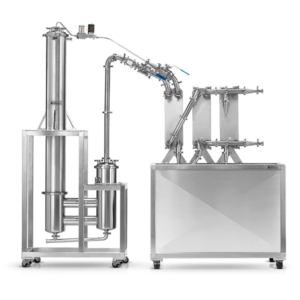
After you have fully saturated your ethanol solvent with cannabinoids and terpenes it’s now ready to go into the evaporator for separation. This part of the process removes the ethanol solvent resulting in a crude hemp or cannabis oil.
Our innovative FFE Series Falling Film Evaporator is ideal for hemp or cannabis oil separation and ethanol alcohol recovery from your extracted biomass tincture. The FFE is a semi-continuous, very rugged, and reliable solvent recovery platform that system maintains a high evaporation rate, which significantly increases the throughput of crude oil production, eliminating the need for multiple large rotary evaporator systems.
How does it work?
During operation, the tincture is syphoned into a closed system at low pressure. A flowmeter regulates the rate at which the tincture is shotgun fed onto a heated evaporator column down which it flows in a laminar fashion. This thin film distribution of the tincture allows for very efficient exposure of the solvent to the heat from the column.
Gravity pulls the concentrated oil down the column and into a collection column below. As the solvent and some residual crude oil are turned to vapor, they travel along the vapor path to another shorter column and must travel against gravity toward the heat exchangers. Any residual moisture or crude oil that managed to make it through to the secondary column is separated there due to their having greater molecular weights than ethanol. The distilled ethanol is then re-condensed along the heat exchangers before being delivered back as a reproofed solvent.

The process of decarboxylation is essential to produce nearly all refined cannabinoid derivatives and end-products. In order to move on to the next step in the process (molecular distillation or fractional distillation) we need to first decarboxylate the extracted cannabinoids while also removing as many of the lower-boiling point compounds as possible.
In fact, decarboxylation is the most important step in producing cannabis distillate extract of premium quality. While the quality of the biomass, the rigor of the extraction, and the sensitivity of the distillation are also crucial, the only chemistry in the entire cannabis purification process occurs in the decarboxylation reactor.
Decarbing crude oil is the simple process of adding heat to raw ‘acidic’ versions of the cannabinoid molecules (like THCA, CBDA, and CBGA) to release the carboxyl molecule group to convert them to their more easily consumed and more potent versions (like THC, CBD, and CBG).
What is not so simple is knowing which temperature threshold produces the highest quality derivative and is held within the extractor’s realm of expertise.
How does it work?
Decarbing on an industrial scale calls for starting with the correct vessel and our recommendation is a glass vessel. While a steel variant may prove to be sturdier, being able to view your crude oil as it releases CO2 is a vital metric; the more of the vessel visible during operation, the better.
A liquid jacketed reactor is ideal as it provides full visibility of the extract throughout the reaction, and also allows for unparalleled control of the heat level within the vessel. The capability to increase the temperature incrementally is most desirable.
Budget reactors will often come with a jacket heating mantle that will be temperamental, and often overshoot the heat it delivers to the chamber if not handled very carefully. This can be catastrophic as overheating cannabis oil can convert desired products or even carbonize it, complicating downstream processing.
Once the oil has been decarbed it is then ready for distillation and further refinement.

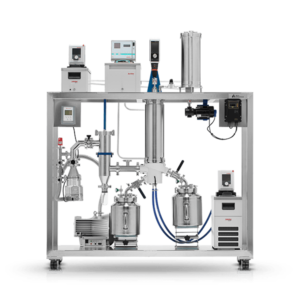
Welcome to the final stage of the process: distillation.
Here we separate out the purified THC, CBD, CBG, and other desirable compounds from the decarbed crude oil to produce highly sought-after distillate which goes on to be transformed into multiple end-products. From vape juice to tinctures to gel caps, it all starts out as distillate.
Our Rolled Film Short Path Distillation technology is engineered to refine targeted compounds from crude botanical extracts and deliver clear distillate at fast speeds. Featuring durable stainless-steel construction to enhance heat transfer capacity, the RFD-27 is a must-have for your ethanol extraction suite if you’re wanting to produce the highest quality and purity of Category A distillate.
Regarding the distillation of cannabis or hemp oils in a lab setting, a workflow involving multiple cuts to remove several fractions of terpenes from decarboxylated crude oil ensures the absolute deepest vacuum possible during the cannabinoid pass.
These terpenes must be removed as their highly volatile nature creates vapor pressure, which in turn increases the volume of gas that must be displaced by the pump to achieve a desirable distillation pressure for the desired oils.
After this step, preliminary fractions often referred to as the, “tails” will be distilled. This fraction is usually of lower quality and is separated from the main fraction known as the, “heart” fraction of the distillation which will yield the more pristinely colored and pure distillate.
The end portions of the distillation will also present with subpar quality oil that is separated and is also referred to as, “tails” fractions and used for products such as edibles or topicals as opposed to the highest quality distillates that are often used in vape cartridges.
How does it work?
Common to many labs, a traditional short path distillation array consists of a large boiling flask typically made of a Borosilicate glass. This material is resistant to the immense amount of heat it is meant to endure during a distillation.
Along the vapor path a condensing coil will be connected through which chilled water or an analogous fluid will be run for the purpose of condensing distillates.
One or more receiving flasks are situated just under the tip of the condensing surface for the collection of the purified fractions of the distillation.
Occasionally, multiple stages of condensers are used to isolate components that have boiling points that are far enough apart that the vapors from each can be selectively captured by the condenser chilled to condensing temperature of each substance, respectively. This technique is known as fractional distillation.


